Sunday, 22 August 2010

Not fiddling for change/Julia Fischer/Chamber Prom/16 August 2010

Julia Fischer’s violin playing is an exercise in effortlessness. As the 28 year old German lifts her 1742 Guardagnini to her chin, her left hand caresses the strings across the finger board up towards the instrument’s bridge as if to reassure herself that they are all in place and ready to sing.

Her eyes close and her chest lifts in a deep inhalation as her right arm controls her bow’s first downward trajectory – a sweeping gesture as if pushing an unwanted intruder away. With this movement we are immediately engulfed in her music making. Fischer and her instrument are one. And we, her audience begin to fly.

Fischer is a violinist’s violinist. Her playing shuns the showy pyrotechnics of Maxim Vengerov or Nigel Kennedy, though her technical virtuosity easily matches theirs. During her brief interview with Radio 3’s Catherine Bott between works at her recent lunchtime chamber Prom at Cadogan Hall (August 16th) her answer to how can she bring something new to a beloved warhorse like the Franck A Major sonata was, ‘I don’t like the pressure on performers to always bring something new. The Franck is great music and great music is always worth repeating. To bring something new is, I think, an unnecessary expectation.’

A modest yet perfectly sound response to our endless desire for novelty. Fischer is wise. Bott, and we the audience, humbly concurred.

Wednesday, 21 July 2010

Ripe and tasty. Spartacus ROH/Bolshoi 19/7/10

Cheese comes in many forms. The variety on offer for the opening night of Spartacus kicking off the Bloshoi’s season in London was particularly ripe. The waltzing oom-pah of Arma Khachaturian’s lurid score almost distracted us from the goose-stepping ragged Roman army. Their wooden swords, hand-painted helmets and shields had the worn lustre of the am dram costume cupboard. The Roman’s wigs were straight out of central casting – Crassus’s (Alexander Volchkov) was resplendent in pressed curls and highlights, more Julian Clary than Julius Caesar. And Spartacus’s fellow escapees were as much scarecrows as slaves on the run. Such are the tawdry aesthetics of late 60’s Soviet theatrical style. Lest I go overboard, I shall only say the sets had the daube-like quality of work by enthusiastic ten-year-olds.

With such teeth-sticking diary product on display I bow to the genius that is the Bolshoi company. They transcended this tackiness like a troupe of jet-propelled superheroes.

The Bolshoi have a ballet technique that feels less as if it was drummed into them from an early age than if their bodies were somehow formed by the technique itself. And yet their bodies are not some platonic ideal of ballet loveliness, although the perfect lines carried by several of the corps were divine.

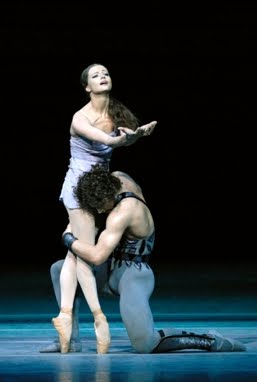
Take Nina Kaptsova (see picture), who danced the role of Phyrgria – Spartacus’s amour. Her limbs are bird-thin and her face a gaunt, she barely looks strong enough to stand let alone manage the gruelling demands of the role. Yet, when her arms are in 5th position – raised above her head – their straightness combined with her lowered shoulders and extended fingers become stems of some exquisite human flower. Held aloft in gravity-defying lifts – her limbs became less human again becoming symbols of human fragility.

Yet she is a pale shadow to the evening’s main event, Ivan Vasiliev’s Spartacus. This man was the reason we leapt to our feet at the final curtain. For he had stunned us with each split-jete en tourant, each tumble and fouette - his upper torso and face thrust at the ceiling as if this time he might, just might break the laws of gravity and take flight.

With his raven curled locks, Rasputin-like dark eyes and the ability to embody character with Stanislavian intensity, Vasiliev just might be the lord of the dance.

Wednesday, 14 July 2010

Sucker Punch, Royal Court, 13/07/10


It's shocking to be reminded of the brutality of racism in 1980s London. When the white working class Charlie (Nigel Lindsay) the thug who runs the south London gym (where Roy William's play is set) calls his black charges 'boy' we know it is the norm. And when he disowns his daughter for 'fooling around' with a black man he is only expressing the common codes of decency.

For the black lads themselves, lighter skinned Troy (Anthony Welsh) feels safe in calling his darker skinned pal, Leon (Daniel Kaluuya), 'rubber lips'. And both of them comfortably jibe the other about being a 'batty man' - the stab that made some last night's audience laugh too. We may remain stony faced a racist epithets, but for some of us homophobic taunts still a source of humour. This is a world of pecking orders based on brute violence, where white is right and status comes in the shape of a flash motor.

For we are in Thatcher's Britain during the Brixton riots - a bleak urban back drop of racial violence. The play's sweaty gym is a microcosm of all the fear, hatred, despair and crass materialism that's being played out on the streets.

Sucker Punch investigates two opposite ways of surviving this brutal landscape. Leon (played by the brilliant, charismatic Kaluuya) keeps Charlie on board to train and manage him, which for Troy is a sell, He is far more radical and violent than his friend. Troy escapes to the States and becomes represented by a black manager. Unlike Leon, Troy feels he's no Uncle Tom.

Yet, both are victims. For this play explores the ideological quagmires that trap young, disaffected black men. The lads are exploited whether they have white managers or not, whether they live in the UK or not. The superb metaphor of Leon being unable to untie his own hand bandages express his real powerlessness.

When Troy and Leon finally fight in the spectacularly staged, slow-motioned climax - Charlie's words resonate, "white people love nuttin' better than to see two black men beat up on each other.".And here we are, the mostly white audience, enjoying the awesome spectacle of just such an encounter - two dark, bloodied bodies in ecstasies of pain and exhaustion smashing the living daylights out of each other. It is thrilling. And sickening.

Interesting to note that this most bloodied and masculine of plays was brought to life by two women - staging by Miriam Beuther and direction by Sacha Wares.

Wednesday, 30 June 2010

Filling the God-shaped hole at the School of Life

I learnt How to Fill the God Shaped Hole at the School of Life last week. The School is ploughing an erudite furrow in the rich intellectual alluvium of Bloomsbury. This is a perfect location as this corner of the capital thrums with the joy of book learning, pondering and cogitating like an auto-didactic librarian on speed. Several colleges of London University are a book toss away.

The School also looks like a bookshop so it’s surprising to walk down to its trompe l’oeil lecture room whose monochrome murals imply a messy, book-filled lounge looking out onto a garden more Hampstead than Holborn. We were fed and watered upstairs first with wine and snacks – the tuck shop before the school bell.

I sat next to Steve who’d had a spiritual revelation the previous week so he thought perhaps his god-shaped hole didn’t need much filling. Others, ‘a flurry of radio 4 listeners’ as someone said, were bright, middle class and mostly female. Many I’m sure were familiar with the residents of Ambridge, but luckily more besides. Several had been to School of Life lectures and sermons before. Students ranged between mid twenties and late forties. One woman was in her sixties.

Our lecturer was Mark Brickman a documentary film maker and all-out renaissance man (he takes several classes at the school). We’d been given homework via email a few days before – exercises in thinking about our spiritual pasts.

Referencing philosophy, cultural history, psychology and anthropology, Brickman took us whistle stop tour of spiritual hole filling. We had breaks to reflect and ruminate like masticating judges on Master Chef. Barely had we sniffed existential philosophy then we were nibbling a ripe slice of St. Augustine, and knocking back Buddhist meditation with a chaser of nihilism. The evening was more running buffet than set menu. Usefully, our input and personal throughts were an important structure for the evening. We kicked off early evening and had finished by 9.30pm.

In a break Steve explained how he was using meditation to assist his dealings as a day trader – perfectly personifying the current trend for all things spiritual while not missing the chance to earn some lucre. ‘It’s not about the money,’ he said, ‘the money is a sign that you’re winning.’

For me, I hadn’t realized I was filling my god-shaped hole with such useful wadding as love, friendship, gift giving and growing strawberries. Useful to be reminded, though.

Evening lectures at the School of Life cost £30


Monday, 14 June 2010

3 Times Table, Triple Bill Royal Opera House 10/6/10


The current Royal ballet triple bill, Chroma, Tryst and Symphony in C runs counter-clockwise. This is wise. Balanchine's paean to classical form - its spectacle of spins, militarily precise corps de ballet and here with Sarah Lamb partnered by Steven McRae (standing in for Ivan Putrov). She was an exotic ingenue at her coming out ball, leaving me giddy and exulted. It's champagne cocktails on an empty stomach. If we'd begun the evening with this, we'd have ended up feeling deflated no matter what came next.

The Royal's embrace and mastery of Balanchine (this was their 51st performance of Symphony) is now total. Paris Opera Ballets Jewels revived last November (with ecstatic sets and costumes by Christian Lacroix) surpasses the Royal for glamour, but our home team's lyrical and technical mastery of the Russian master's 'pure dance' is also world class. It can even outshine New York City Ballet's more thrusting, athletic approach. When will more Balanchines become core repertoire for the Royal? What about an evening of all Stravinsky ballets? Apollo is already in the rep. Why isn't the violin concerto in there too?

Wayne McGregor and Christopher Wheeldon are choreographers have Janus-like responses to the body. McGregor is like a schoolboy holding a magfnifying glass and wondering what happens when you pull, contort or otherwise disturb the balance of dancers spiderish limbs. His movements are deliberately ugly and off kilter yet end up stressing physical perfection when each throw of the hips or awkward head angle resolves itself. It's like Kate Moss gurning followed by her dimpled smile. With nude costumes, a compulsive orchestrated score by Jack White III, Chroma is face-pinching a crowd pleaser.

Tryst should be an even bigger hit. Wheeldon's choreographic language is no dissection of classical technique. It is the beauty and unexpectedness of his positioning of groups, the coming together and parting of couples and his creative collaborations which keep his work up-to-date. Tryste, however, is played out to James MacMillan's discordant, repetitive and sometimes harsh score which is only leavened in the later sections.

Melissa Hamilton's solo followed by her pas de deux with Eric Underwood was pure Wheeldon magic. She danced alone into statuesque arabesques on a back lit stage while Underwood prowled the outer stage like a hungry shadow. Ballet has no more beautiful image of what? Ennui, alienation, loneliness? Whatever, it was poetry manifest. A line from Satre's Being and Nothingness made flesh.

This is the couple to watch.


Thursday, 10 June 2010

Darkness visible, Come, Been and Gone, Michael Clark Co. Barbican 9/6/10

Dancers in metallic orange cat suits, faces pressing to the floor, hips cocked, triangulated legs in static raises as David Bowie’s thrashing guitar rains down the ear-bleedingly loud final chord of The Jean Genie. Light cuts. And the audience, cheering, exuberantly applauds the end of Come, Been and Gone, Michael Clark’s newest work in front of a packed out Barbican last night. The dancers take their curtain calls. Clark himself is in the wings.

The punk ballet master’s absence is a reminder of the darkness we’d just seen before this explosive finale. Dancer Kate Coyne had only minutes before contorted, writhed and staggered in a remarkable body suit pierced with bouncing syringes accompanied by The Velvet Underground’s Heroin.


Clark’s own wrestling with drug addiction is well known. Were we watching biography? If so, Clark is in a much brighter place now, exuberantly reconnecting to his Puck-like self from the mid1980s. His own brief legato presence was muted and shadow-like. Yet Simon Williams and Nathan Cornwall with Clark’s jerky, juddering, stiff-armed choreography are baton bearers of his younger electrifying self.


In the row behind me were Jarvis Cocker, DJs Princess Julia and Jeffrey Hinton and Pop magazine editor, Ashley Heath. Clark’s showmanship and membership of the demimonde have always graced his shows with the best ballet audience in town. And if the music and dancing didn’t grab you urgently enough, those were Peter Doig paintings suspended over the screen at the back of the stage.

Wednesday, 19 May 2010

Wordy Rappinghood, Babel (words) premier, 18/05/10 Sadlers Wells

There has never been such rich choreographic talent condensed in London. For neo-classicism with a dash of modern swagger Christopher Wheeldon Company delivers. Innovative collaborations in a minimalist setting and electronic scores more your thing? Russell Maliphant is the man. If deconstructed movement in a futuristic world gets you going, get cosy with Wayne MacGregor's electrifyingly odd ballets.

If you'd rather see a multicultural mash-up with live, plangent percussion and dizzying physical pyrotechnics, Akram Khan will always oblige. Alongside Khan now stands Sidi Larbi Cherkaoui whose Babel (words) premiered at Sadlers Wells last night.

As the title suggests, Babel is about language - that which as likely communicates as baffles. With a a linguistic and physically diverse smorgasbord of 16 international dancers and a playground of endlessly moveable and stackable wire boxes by sculptor Antony Gormley, we were entertained with the surreal, the barmy and the silly. A PVC clad glamazon (one part robot to two parts catwalk diva) was variously an automaton and a passive/aggressive airport security officer. She was also subject to extreme male attention - provided first by a pair of gabbling prodders to a fully-fledged regression by a French man to a cro magnon state. And back again - luckily.

What defines so much of this modern dance making and is true of Babel is the number of cross-fertilisations between artists happening now - pulling off something together that's bigger than a solo creator could manage. Cherkaoui collaborated with Damien Jalet on the movement and on the design with Antony Gormley. In the past he's also worked with Akram Khan and the drumming Shaolin monks.

It is this willingness to work across artistic boundaries that keeps these works surprising. And at times indulgent. With so much excitement about such collaborations there's always the risk of a lack of focus and editing that was evident here. A swift prune of 20 minutes of repetitive action, such as the relentlessly spinning boxes (we get it, language can put you in a spin!) would have made for a tighter, more immediate work.

The final image of Babel is a motley row of dancers attempting a kind of lunar walk with entwined legs - totteringly, hesitantly they stagger towards the audience - a slow motion wave that doesn't quite break. A beautiful final image then for our struggle to connect and the near impossible tasks of creative collaboration itself.