Friday, 18 March 2011

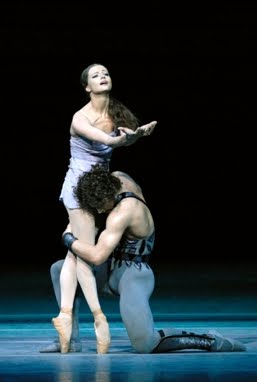
Idiot Tales. The Most Incredible Thing, Pet Shop Boys/Javier de Frutos World Premier, Sadler’s Wells 17/3/11


Stages are mouths into which you can throw the world and their gaping maws will hunger for more. This truth must be haunting the ‘dream’ collaborators of the Pet Shop Boys and choreographer Javier de Frutos today after last night's world premier. They threw every device they could think at this ill-conceived reworking of the Hans Anderson tale - dancers, spoken word, dramatic lighting effects, spinning, whirling scenery yet the Sadler’s Wells stage was left chewing a pea.

Theatrical works live by creating a world, an order into which the action, dance or drama can fit. It doesn’t have to be believable, but it needs logic. Without it the audience is left with the empty spectacle of increasingly futile gestures. Three buxom muses leapt engagingly at our hero as he tried to make the most incredible thing. They were referencing Balanchine’s great ballet, Apollo in their mirrored gestures and mini Grecian togas. But it compared vintage champagne to Thunderbird, making de Frutos’s desperate dance making all the more lame by association with a work of genius.

The evening's doom was flagged up early by the show’s nervous producer asking us to indulge our patience, that this was a world premier and things just might go wrong. These must be the wisest words she’s uttered since taking up this ill-fated project.

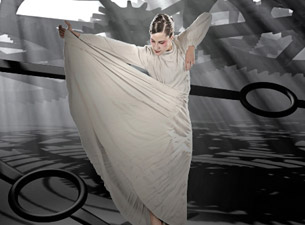
It was as if the whole piece lacked a director for it lacked sense. Who with a full-blooded frontal cortex would have agreed to such impressive, but distracting, animation effects (courtesy of BAFTA-winning animator Tal Rosner). It made the frantic leaps of the dancers like mosquitoes beneath a blazing sun.

We left after the second act – the curtain dropped as the cartoon king was thrown spinning across the stage. Behind us two conspicuously empty seats in the centre of Row A of the Circle. It was a low-key, elegant, gesture of disapproval. If only the creators of this debacle could have engaged with these concepts rather than empty bombast they were so determined to nail.

Thursday, 17 February 2011

Douglas Gordon's K.364


I was lucky. When I entered the labyrinthine screening halls (there are two wall-sized angled screens showing different angles of the same scene from Douglas Gordon's latest film, K.364) the piece was in the midst of the exuberant first movement of Mozart's Sinfonia Concertante for violin and viola (aka K.364, the codified numbering system used to catalogue Mozart's oeuvre). Two Jewish men were doing what they do best - playing their instruments with a gritty immediacy. The intimacy of the camera work with the head of the conductor slipping into view and blurred instrumentalists from the orchestra in the background while her hands danced into shot gave a strange almost slo-mo conter-point to the music's jaunty dotted rhythms.

I've heard the rest of the film dips into pretension with the prolonged train journey taking the musicians from Berlin to Warsaw for the concert I was so enjoying. Train journeys carrying Jewish passengers from West to East have obvious Holocaust-era symbolism. Our two you men talk about their forebears taking a similar route 70 years ago to their deaths, not to make music.

But there are other resonances here too. In 1943 a women-only orchestra was created at Auschwitz concentration camp. The musicians were protected from being gassed or worked to death by their luck at playing an instrument. At one point, a woman called Alma Rose was the conductor of the orchestra, Gustav Mahler's niece.

1941 was the 150 anniversary of Mozart's death. Under Joseph Goebbels, Hitler's Propaganda Minister, the first music festival devoted to the Austrian composer was given, book-ended by a Nazi burial ceremony for the composer. Wreaths from Hitler, Goering and the SS were displayed outside Romanesque-Gothic St Stephen's Cathedral in Vienna at the festival's close.

Can Jews comfortably play Wagner's music because of his well-known anti-semitism as well as his appropriation by the Nazis? Wagner's music was often played at Nuremberg rallies. Mozart doesn't generate the same ambivalences no matter who is playing him. The librettist of his most important operas, Lorenzo da Ponte, was a Jew and Mozart's enthusiastic membership of the Masons was conveniently air-brushed by the Nazis.

Tuesday, 1 February 2011

John Stezaker, Whitechapel Gallery until March 18th


The pleasure of looking at John Stezaker's work is the shiver of seeing something banal made strange. Studio shots of long-dead actors and hand tinted postcards of waterfalls and landscapes are hackneyed and banal. But when Stezaker lays one of these tired images on top of another, or just slices or folds into a photograph, a strange alchemy takes place. Jolted, we see both the material reality of the photo - look it's been chopped up! while still being seduced by the tidal pull of its image.

Like all collage - these pictures play games with our visual perception. While much collage, even going back to Picasso, overlays multiple images in an attempt to make weighty what is ultimately so light, ephemeral and playful - the chance encounter of images and their kaleidoscopic associations. Here is a more controlled simplicity - Stezaker uses only two images at most. His collage is minimalist.

Stezaker isn't only referencing those great collagists Braque and Picasso, but Magritte too (especially the shadow cutout figures at the beginning of the exhibtion), but mostly Dali. What other image comes to mind when looking at Mask XXXV from 2007 than Dali's Paranoiac Visage of 1935. Stazaker's collages aren't just made of layers, they also lay themselves at the feet of Surrealism's greatest master.

Sunday, 30 January 2011

Friends indeed. The King's Speech


The unlikely friendship between Lionel Logue and George VI is the real appeal of The King's Speech. The very unlikelihood of a bond between an Antipodean liberal and the stiffest of stiff upper lipped Royal is compelling. It shouldn't work and it almost doesn't. But somehow it does, and beautifully.

For what this film promises us on a deep level is that we too might find someone who will see us who we really are. It's a kind of love story played out through a chaste friendship, but is no less profound and meaningful for that. It's the yearning we have not for a return to our mother or father's embrace but for the companionship of a sibling. One who will play with us always.

Tuesday, 25 January 2011

Tutu much. Black Swan - on release


Nina (Natalie Portman) is a good girl and good girls do ballet. She trots to class swathed in snow-frosted scarves and the sort of buttoned up pink coats worn by prim 5-year-olds. Nina is a superb ballerina (and credit to Portman for losing 9 kilos and going up on pointe - ballet's unique form of female torture). But does she have the dark passion to take on classical ballet's most demanding role? Odette/Odlie - the Swan Queen and the Black Swan? That so-tired-it-actually-died-5-centuries-ago virgin/whore claptrap.

This is the narrative thrust of this trash-gothic-campy film in which we see NIna thrust and thrash in an onanistic bed-ballet scene after her lusty svengali (Vincent Cassel) tells her to get in touch herself 'down there'. Which is really what this over blown and silly film is about. It's about Natalie Portman's body - scarred, scratched, feathered and fondled. It's also about her nemesis, a flashy dance rival (Mila Kunis) who dives between her thighs like a hungry cat.

The dance scenes are well filmed, although this viewer got giddy from too many spinning cameras. But what really fascinated me was the packed house at Notting Hill's Gate cinema last Sunday night. What were we all thinking we were about to see? A film about ballet? You're more likely to get an audience to watch a test card. We were there to see the cheap pleasures of soft porn dressed up as art-house cinema. We didn't leave disappointed.

Saturday, 22 January 2011

Death Becomes Her - Giselle, Royal Ballet, ROH 19/1/11


Deep are the satisfactions to be found in Giselle currently playing at the Royal Opera House until next month. Set designer John Macfarlaine’s pastoral setting for the maid’s cottage in the first act is little more than a rustic clearing on the edge of an engulfing wood. While his Second Act places Giselle’s grave in a post-apocalyptic blasted forest of tumbled trunks and mangled roots. These are the romantically sublime backdrops for ballet’s first tale of tragic love - nature rendered as a diabolical twin to our heart's own darkness.

Last night’s leads - Leanne Benjamin (Giselle) and Edward Watson (Albrecht) – were a couple we’d instantly place together. Which deepens our shock at Albrecht’s deceit – his two-timing of Giselle with another. These are young lovers who belong together making Giselle’s breakdown and death – a frenzy of tumbling hair, head-clasping bowed stillness as compelling as it is understandable.

Friday, 7 January 2011

Genius of Mozart, BBC Radio 3, 1-12 January 2011

Two thoughts strike me listening to back to back Mozart playing now on Radio 3.

My radio is in my bedroom, so I hear the music from the distance of my living room/office and it sounds like there's a party going on back there. A late 18th century house party. Mozart's music is a witty raconteur endlessly keeping his audience chuckling with delight; hia nudging sauciness, mirth and joy. He's irrepressible - impossible to resist. And even when the music turns towards the shadows as it does in the slow movement of the Clarinet Quintet K 581, there is still beauty - an aching melancholy.

My other thought is about Mozart's unsurpassed invention. Take the sonata for two pianos, K448 of 1871 written when he was 25. Like so much classical music this is built on the idea of a theme and its variations. A simple melody is inverted, ornamented, stretched, shrunk and played with before returning to its original form. This is classic sonata form. It is a journey that yo-yos back to its beginning.

Yet the melody is refreshed and renewed upon its return. And this particular melody and journey improves the spatial awareness center of our brains, known as the 'Mozart Effect'. Sufferers of epilepsy had fewer seizures after listening to this sonata, according to the British Epilepsy Organization. So I'm left marveling at Mozart's joyful invention that is also - hurrah! - improving my brain.

Monday, 22 November 2010

Too far? Wayne McGregor, Random Dance


Wayne McGregor - the most celebrated choreographer working in the world today - could be running out of ideas. In his new work, Far, which premiered last Wednesday at Sadler's Wells - his supremely talented Random Dance performers contorted their lithe bodies into the choreographic maestro's usual eye-watering, asymetrical shapes. Narrative-free, abstract and compelling, the man's aesthetic is to deconstruct the pleasing lines we associate with ballet to uncover what lies beneath. The answer - compelling oddity. Afterall, whatever these dancers do to their bodies as they are young, supremely talented and hot. Ugliness isn't part of their DNA.

Far is presented on a bare stage apart from a large white rectangular light installation by Lucy Carter for rAndom International.The piece's pinned lights sweep, high-light and scintillate from crazed disco effect what looked like running water. It is brilliant and mesmerizing. And it is also distracting. I found myself watching its lucid pyrotechnics more than I was the dancers in the foreground. This might be forgiveable in an art gallery where this work could be seen as an art piece rather than a dance performance. McGregor's collaborations are fascinating, he's worked with Juilan Opie, Joby Talbot and the White Stripes in past productions, especially 2006's Chroma - his most popular and greatest work to date.

With this piece, McGregor takes his inspiration from Roy Porter's posthumous book, Flesh In the Age of Reason on which the work draws it's name (an acronym) and inspiration. But who can tell?

Wednesday, 10 November 2010

Time Lord, Marclay's The Clock, White Cube Mason's Yard till November 13th


Video artist Christian Marclay's 'The Clock' is the most original timepiece in the world because it's a film. A film that tells you the time by using every kind of movie that's ever had a shot of a clock, a character glancing at their watch or a bank robber muttering something like, 'It's now 2.29, the bomb will explode in 31 minutes!'.

The film runs for twenty-four hours - a mash up of black and white, Hollywood blockbuster, foreign language, schlock, glitz, tack (indeed, that is Jack Nicholson singing, ''It's three twenty five" to a glitter-eyed babe), art house, adventure, western, rom com, musical and drama.

The only narrative thread, is time, everything else is back story. The film's characters are telling, seeing, ignoring or responding to time as it happens. Yet these moments are fictions from source material that span over 80 years of film product. It's a dizzying concept made real via thousands of hours research on a spaghetti mountain of footage. For who can remember a great panning shot that features a clock from any film? Let alone the precise moment it happened.

It's tempting to say something clever about how 'The Clock' explores the fragmentation of time by deconstructing time's logic and rationality. I could even give it a psychoanalytic spin and see this work as a carnivalesque subversion of tyrannical super-ego 'father' time. A cocked-up clock, perhaps.

But what struck me most was the enormous pleasure this piece gives its audience. Just hear those gasps of pleasure at each audacious moment of time-revealing footage!

So remove your watch, sit back, and enjoy the ride of your life.

Tuesday, 2 November 2010

Two operas and a dance off - Gluck, Monteverdi and Pina Bausch 28/29th October 2010


The development of opera in its first 150 years was a refinement of the melodic line and the bringing together of evermore complex vocal groups before the shuddering emotional onslaught of the Romantics at the end of the 18th Century. The same thing happened to pop when rock 'n roll first charged the solar plexus. To compare opera's first great master, Monteverdi (17th C) with Gluck (18th C) over a hundred years later is to consider two ends of a logically pleasing developmental arc.
Yet there is emotional depth in even the earliest operas. The fact that Monteverdi took the story of Nero and Poppea for his last and greatest opera showed a willingness to take on historically accurate human frailties rather than the mores of mythological gods and monsters. Although it takes a leap of the imagination still to see murderous Nero sung by a slight mezzo-soprano, Lucia Cirillo, in the Glyndebourne Festival production currently on tour.
Transplanted to a 1930s Italy, we can read the dictator as a proto Mussolini - all slicked down hair and puffed up vanity. Christiane Karg's Poppea was out sung and out performed by Louise Poole's slighted and murderous Empress Ottavia. While the chicly minimal set - little more than a series of heavy red drapes (symbolizing blood and love) created palaces and bathrooms with simple rearrangements. For a touring production this feels neat and mobile. For a more permanent production its unrelenting simplicity is underwhelming.

A note on Glyndebourne itself. This was my first time. Thankfully there weren't the penguin-suited opera toffs as this was out off season, but the rolling grounds and the round elegance of the theatre itself conjured a quieter kind of magic. I was smitten. For the theatre itself is simple and intimate and was obviously developed by those for whom the art of opera itself is paramount rather than as a crass paean to snobbery. It is a place designed for art.

Choreographer Pina Bausch once said, 'I'm not interested in how people move, but in what moves them.' What obviously moved her in 1974 was the limpid beauty of Gluck's opera Iphigenie auf Tauris against which she created a full length ballet where her signature motifs the hand clenched staggers, the tossed hair of a lead woman both troubled and seductive and the intsensity and precision of her groupings conjure the horror/comic paintings of Paula Rego. Bausch was a unique choreographic artist (she died in 2009) whose works are as much theatrical happenings, art pieces - calling them dances diminishes their absorbing power. This use of a late baroque opera requiring a full orchestra, soloists and chorus shows her pushing choreography into unlikely but rich territory. Would Mark Morris have had his love affair with the purity of the baroque (in his case, Handel) without this ground-breaking innovation from Bausch?
Or, in fact, would we even be seeing 'Poppea' with Bausch and her ilk's audacity 40 years ago.

Tuesday, 19 October 2010

Psychoanalysis exhibition Science Museum 15/10/10

This small exhibition is set aside from the main drag of the Science Museum as if acknowledging the shaky idea that psychoanalysis is science. Freud urged it to be regarded as such. But psychoanalysis' status as hard science has always remained questionable. There are no courses in it at London's premier science school, Imperial College, for example.

According to the notes (and there are plenty of these throughout this exhibition) latest research in cognitive neuroscience is uncovering a body of evidence for unconscious mental activity. Ah ha, it is a science then!

Yet this is no proof of the unconscious as conceived by Freud. For him, the unconscious is a dung heap of repression and suppression where all our unmanageable feelings and fantasies fester. Neuroscience has yet to find this odure of the mind.

The closest to any kind of heap in the exhibition is the Noble and Webster sculpture a tsunami of red cocks, balls and hands (molds from their own bodies) which are lit to cast a shadow on the wall behind of the artists' silhouettes. Its a modern take of that profile cartoon of Freud with his nose and forehead made up of the outstretched torso of a naked women.

What is frustrating about this exhibition apart from being assailed by recorded voices of analysts explaining their work and plaques with overly long explanations of analytic techniques was the exhibition's sense of defensiveness. It seemed to be saying, rather with it's back to the wall, we really do belong in the august surroundings of the Science Museum. It feels vaguely muted and slightly muddled like a tormented soul stepping over the threshold for her first analytic session and unsure where to sit.

There's also a problem of voice - the explanations were both too esoteric - caught up in the highly specialist jargon of analysis - yet also too trite. The glass case with everyday objects - shoes, toy sports cars etc. that might unconsciously conjure for ourselves fantasies of status, youth, sexiness etc are today Sunday supplement cliches. We know this stuff already.

Also, anaysis is less a theory of mind than an active practice of healing. There were no patients in the exhibition apart from the drawings by one of Melanie Klein's child patients - his drawings of his father as Hitler were inevitably richly revealing. Though the photos of different analysts' empty therapy rooms merely showed that analysts have the same bad taste in interiors as the rest of us.

And yet, to see Freud's own copy of The Interpretation of Dreams (English trans 1913) - his greatest work - alongside his beloved objects from classical antiquity including the miniature Sphinx that was central to his theory of the Oedipus complex is thrilling. These very objects were the torches with which this creator of the talking cure shone a light into the darkest recesses of the human psyche. And we are still blinking in its intense illumination.


The exhibition also includes works inspired by psychoanalytical ideas include pieces by Arnold Dreyblatt, Mona Hatoum, Joseph Kosuth, Grayson Perry, Sonny Sanja Vadagma, Tim Noble and Sue Webster.

Monday, 11 October 2010

Soprano Soile Isokoski Wigmore Hall Monday 11th October

The revelation of today's lunchtime concert wasn't Isokoski's limpid rendering of Schumann's Liederkries (Op. 39), it was the four songs she sang by Henri Duparc. This is a composer I've never heard of before. He stopped composing music at 36 after a nervous illness made it impossible for him to continue. What a loss. He lived for another 40 years and Duparc would have been a name we know - as long as he'd carried on creating songs like these.
There is a tension in his music between a yearning for German romanticism - Duparc was a fan of Schumann, Schubert as well as being a fervent Wagnerite. The fact he wrote lied is proof enough, perhaps. Yet, as a Frenchman he was resistant to the dominance of German art and culture and his studying (piano) with the arch-French composer Cesar Franck gives his music that diffuse quality that is uniquely French. These are songs are silk to wrap yourself in.

There is a piercingly precise quality to Isokoski's lyric soprano voice that thrills. My companion was gobsmacked to hear there was no augmentation to her voice. Were were sitting 20 rows back and the piercing insistence of her fortissimo top notes rained down on us like diamantine hail.

Thursday, 7 October 2010

Through a Mirror, Darkly. Vertical Road, Akram Khan Co. Sadler's Wells 6th October 10


These are the three things I learnt from Vertical Road, Akram Khan's newest dance work that premiered a couple of months back and was seen in London for the first time last week -

Dusting crouching dancers in chalky dust or talc makes for a vivid opening tableau, when they start moving the dust flies off them like smoke (see picture).

Tai chi is compellingly inventive source material for dance.

Loud, repetitive drum beats become annoying after about three minutes.

Oh, and make this a fourth – either tell a story, or don’t. Opaque suggestions of narrative are frustrating – like a fuzzy screen that occasionally coalesces into a movie. Make it both and annoy the hell out of your audience.

Khan didn’t perform which was a shame as he - spellbindingly - is both feral and controlled like a leaping tiger. Although it was hardly making do to watch Salah el Brogy as his central male figure – in equal parts, yogi and Christ. And sex god.

Wednesday, 22 September 2010

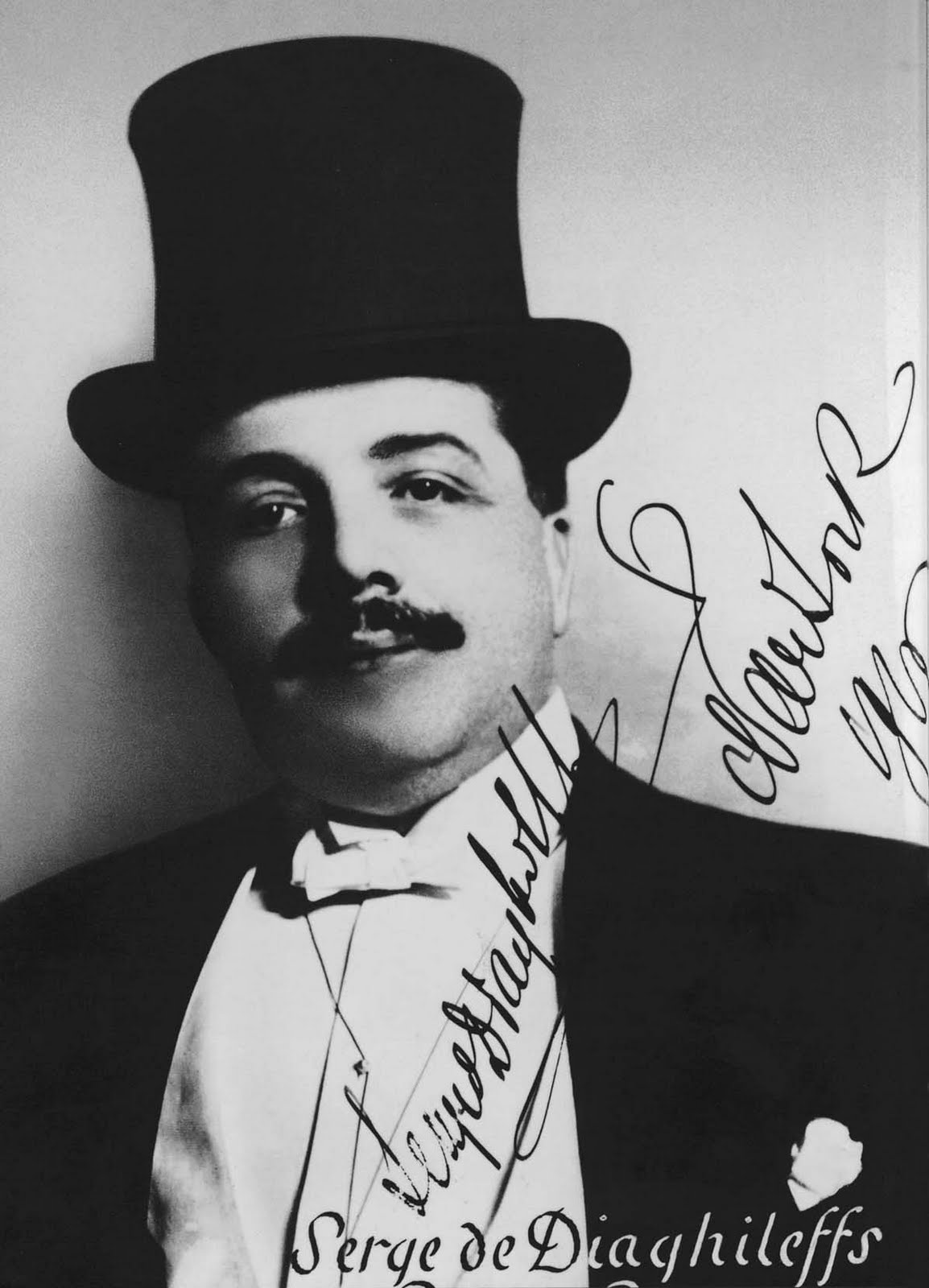
Diaghilev and the Golden Age of the Ballet Russes, V&A. Opens 25 September 2010

For Henri Matisse Sergey Diaghilev was Louis XIV, while Claude Debussy described him as '.. that terrible and charming man, who could make stones dance.'

Sergei Diaghilev was also described as a devil, a provocateur and a thief, but a hundred years on from the first glittering explosion of the Ballet Russes onto the Paris stage, we surely can only conclude the man was a bullish persuader with a nose for excellence all wrapped up with a phenomenal work ethic.

Sergey Diaghilev cajoled, lured, bullied, flattered and extorted the greatest names in modern art, including Stravinsky, Matisse, Picasso, Nijinsky, Chanel and Balanchine - urging them to collaborate on the most breathtakingly new theatrical productions the world had ever seen. It's a heritage that kick started the collaborative arts and establishmed modern ballet companies that seem such a permanent part of our cultural landscape now.

Of course, his only tangible legacy are the delicately faded costumes, properties and sets at, 'Diaghilev and the Golden Age of the Ballets Russes 1909-1929' which is about to open as the glittering jewel in the V&A's autumn schedule.

The conceit of the exhibition is that we've stumbled back stage at a Ballets Russes performance. Walls are painted darkly, there are highlights and illuminations as if from a nearby stage. Music, particularly Stravinsky's Rite of Spring, seems to lure us deeper into the exotic gloom. This concept works well for Diaghilev was averse to his productions being filmed, there is barely any footage. We are only left with eye witness reports, ballet notation of the choreography and the properties themselves. The exhibition's corners are taken up with ladders, suitcases and boxes - the jumbled detritus of a touring dance company.

And, boy, did the Ballet Russes tour! The US, Europe and Latin America were all regularly blessed with the company's presence, but sadly never Russia itself due to Diaghilev's own complex feelings towards his homeland and the 1917 revolution that put paid to any further thoughts of his triumphal return. Revenue from touring just kept the company's expensive calvalcade afloat. Although Diaghilev was constantly on the run from an ever growing army of creditors.

It was that cultural bomb of Russia's revolution which seemed to shift the company's aesthetic away from the post-belle epoque exoticism of ballets like Sheherazade, The Rite of Spring and The Firebird towards a cooler, pared down modernism found in works of the 1920s like Le Train Blue, Chout and Apollon whose simple grecian tunics were designed by Coco Chanel typifying the androgynous mood of the Jazz Age.

Perhaps the most vivid quote about Sergey Diaghilev comes from Jean Cocteau, another of his many collaborators, 'That ogre, that sacred monster... that Russian prince to whom life was tolerable only to the extent to which he could summon up marvels.'

And what marvels they were. Do whatever you can to see them before they fade from sight forever.


Wednesday, 8 September 2010

Fauning over the volume. l'Orchestre National de France, Prom 71, 7/9/10


What’s not to love about a programme including two of Debussy’s most famous works, Prelude a L’Apres midi d’un Faune and La Mer, alongside the 20th century’s most (in)famous ballet score, Le Sacre du Printemps (The Rite of Spring)? There was certainly giddy expectation in the Albert Hall last night - musical devotees knowing exactly what they were about to receive.

Conducted by their (relatively) new music director, Daniele Gatti, l’Orchestre National de France were on stunning form (apart from an unseemly pile up by the brass section at the close of Dance of the Earth in Rite). Most distinctive perhaps was not the plangent sonorities of the fortissimi in La Mer and, of course, the Rite; but rather the exquisite, almost mystical, quietude that Gatti conjured from his 120-strong orchestra. It was this contrast, a kind of aural chiaroscuro between loud and soft, that gave these familiar pieces fresh mystery.

Perhaps it also comes from a particular kind of sensitivity of the predominantly French players to music that is such a part of their national culture? Sure, Stravinsky was Russian, yet what other piece of avant-garde music is more associated with Paris than this? There was that mythic riot in the Theatre Champs-Elysees at its premier on 29th May 1913.

Without these three works would 20th Century music have taken the adventurous course that it did? The breakdown in diatonic tonality towards dissonance and atonality, the shift from melody towards rhythm and the assertion of wind and brass over the violin’s orchestral dominance are all prefigured here.

But perhaps, more than any of this, these works taught us to listen with new ears.

Sunday, 22 August 2010

Not fiddling for change/Julia Fischer/Chamber Prom/16 August 2010

Julia Fischer’s violin playing is an exercise in effortlessness. As the 28 year old German lifts her 1742 Guardagnini to her chin, her left hand caresses the strings across the finger board up towards the instrument’s bridge as if to reassure herself that they are all in place and ready to sing.

Her eyes close and her chest lifts in a deep inhalation as her right arm controls her bow’s first downward trajectory – a sweeping gesture as if pushing an unwanted intruder away. With this movement we are immediately engulfed in her music making. Fischer and her instrument are one. And we, her audience begin to fly.

Fischer is a violinist’s violinist. Her playing shuns the showy pyrotechnics of Maxim Vengerov or Nigel Kennedy, though her technical virtuosity easily matches theirs. During her brief interview with Radio 3’s Catherine Bott between works at her recent lunchtime chamber Prom at Cadogan Hall (August 16th) her answer to how can she bring something new to a beloved warhorse like the Franck A Major sonata was, ‘I don’t like the pressure on performers to always bring something new. The Franck is great music and great music is always worth repeating. To bring something new is, I think, an unnecessary expectation.’

A modest yet perfectly sound response to our endless desire for novelty. Fischer is wise. Bott, and we the audience, humbly concurred.


Wednesday, 21 July 2010

Ripe and tasty. Spartacus ROH/Bolshoi 19/7/10

Cheese comes in many forms. The variety on offer for the opening night of Spartacus kicking off the Bloshoi’s season in London was particularly ripe. The waltzing oom-pah of Arma Khachaturian’s lurid score almost distracted us from the goose-stepping ragged Roman army. Their wooden swords, hand-painted helmets and shields had the worn lustre of the am dram costume cupboard. The Roman’s wigs were straight out of central casting – Crassus’s (Alexander Volchkov) was resplendent in pressed curls and highlights, more Julian Clary than Julius Caesar. And Spartacus’s fellow escapees were as much scarecrows as slaves on the run. Such are the tawdry aesthetics of late 60’s Soviet theatrical style. Lest I go overboard, I shall only say the sets had the daube-like quality of work by enthusiastic ten-year-olds.

With such teeth-sticking diary product on display I bow to the genius that is the Bolshoi company. They transcended this tackiness like a troupe of jet-propelled superheroes.

The Bolshoi have a ballet technique that feels less as if it was drummed into them from an early age than if their bodies were somehow formed by the technique itself. And yet their bodies are not some platonic ideal of ballet loveliness, although the perfect lines carried by several of the corps were divine.

Take Nina Kaptsova (see picture), who danced the role of Phyrgria – Spartacus’s amour. Her limbs are bird-thin and her face a gaunt, she barely looks strong enough to stand let alone manage the gruelling demands of the role. Yet, when her arms are in 5th position – raised above her head – their straightness combined with her lowered shoulders and extended fingers become stems of some exquisite human flower. Held aloft in gravity-defying lifts – her limbs became less human again becoming symbols of human fragility.

Yet she is a pale shadow to the evening’s main event, Ivan Vasiliev’s Spartacus. This man was the reason we leapt to our feet at the final curtain. For he had stunned us with each split-jete en tourant, each tumble and fouette - his upper torso and face thrust at the ceiling as if this time he might, just might break the laws of gravity and take flight.

With his raven curled locks, Rasputin-like dark eyes and the ability to embody character with Stanislavian intensity, Vasiliev just might be the lord of the dance.

Wednesday, 14 July 2010

Sucker Punch, Royal Court, 13/07/10


It's shocking to be reminded of the brutality of racism in 1980s London. When the white working class Charlie (Nigel Lindsay) the thug who runs the south London gym (where Roy William's play is set) calls his black charges 'boy' we know it is the norm. And when he disowns his daughter for 'fooling around' with a black man he is only expressing the common codes of decency.

For the black lads themselves, lighter skinned Troy (Anthony Welsh) feels safe in calling his darker skinned pal, Leon (Daniel Kaluuya), 'rubber lips'. And both of them comfortably jibe the other about being a 'batty man' - the stab that made some last night's audience laugh too. We may remain stony faced a racist epithets, but for some of us homophobic taunts still a source of humour. This is a world of pecking orders based on brute violence, where white is right and status comes in the shape of a flash motor.

For we are in Thatcher's Britain during the Brixton riots - a bleak urban back drop of racial violence. The play's sweaty gym is a microcosm of all the fear, hatred, despair and crass materialism that's being played out on the streets.

Sucker Punch investigates two opposite ways of surviving this brutal landscape. Leon (played by the brilliant, charismatic Kaluuya) keeps Charlie on board to train and manage him, which for Troy is a sell, He is far more radical and violent than his friend. Troy escapes to the States and becomes represented by a black manager. Unlike Leon, Troy feels he's no Uncle Tom.

Yet, both are victims. For this play explores the ideological quagmires that trap young, disaffected black men. The lads are exploited whether they have white managers or not, whether they live in the UK or not. The superb metaphor of Leon being unable to untie his own hand bandages express his real powerlessness.

When Troy and Leon finally fight in the spectacularly staged, slow-motioned climax - Charlie's words resonate, "white people love nuttin' better than to see two black men beat up on each other.".And here we are, the mostly white audience, enjoying the awesome spectacle of just such an encounter - two dark, bloodied bodies in ecstasies of pain and exhaustion smashing the living daylights out of each other. It is thrilling. And sickening.

Interesting to note that this most bloodied and masculine of plays was brought to life by two women - staging by Miriam Beuther and direction by Sacha Wares.

Wednesday, 30 June 2010

Filling the God-shaped hole at the School of Life

I learnt How to Fill the God Shaped Hole at the School of Life last week. The School is ploughing an erudite furrow in the rich intellectual alluvium of Bloomsbury. This is a perfect location as this corner of the capital thrums with the joy of book learning, pondering and cogitating like an auto-didactic librarian on speed. Several colleges of London University are a book toss away.

The School also looks like a bookshop so it’s surprising to walk down to its trompe l’oeil lecture room whose monochrome murals imply a messy, book-filled lounge looking out onto a garden more Hampstead than Holborn. We were fed and watered upstairs first with wine and snacks – the tuck shop before the school bell.

I sat next to Steve who’d had a spiritual revelation the previous week so he thought perhaps his god-shaped hole didn’t need much filling. Others, ‘a flurry of radio 4 listeners’ as someone said, were bright, middle class and mostly female. Many I’m sure were familiar with the residents of Ambridge, but luckily more besides. Several had been to School of Life lectures and sermons before. Students ranged between mid twenties and late forties. One woman was in her sixties.

Our lecturer was Mark Brickman a documentary film maker and all-out renaissance man (he takes several classes at the school). We’d been given homework via email a few days before – exercises in thinking about our spiritual pasts.

Referencing philosophy, cultural history, psychology and anthropology, Brickman took us whistle stop tour of spiritual hole filling. We had breaks to reflect and ruminate like masticating judges on Master Chef. Barely had we sniffed existential philosophy then we were nibbling a ripe slice of St. Augustine, and knocking back Buddhist meditation with a chaser of nihilism. The evening was more running buffet than set menu. Usefully, our input and personal throughts were an important structure for the evening. We kicked off early evening and had finished by 9.30pm.

In a break Steve explained how he was using meditation to assist his dealings as a day trader – perfectly personifying the current trend for all things spiritual while not missing the chance to earn some lucre. ‘It’s not about the money,’ he said, ‘the money is a sign that you’re winning.’

For me, I hadn’t realized I was filling my god-shaped hole with such useful wadding as love, friendship, gift giving and growing strawberries. Useful to be reminded, though.

Evening lectures at the School of Life cost £30


Monday, 14 June 2010

3 Times Table, Triple Bill Royal Opera House 10/6/10


The current Royal ballet triple bill, Chroma, Tryst and Symphony in C runs counter-clockwise. This is wise. Balanchine's paean to classical form - its spectacle of spins, militarily precise corps de ballet and here with Sarah Lamb partnered by Steven McRae (standing in for Ivan Putrov). She was an exotic ingenue at her coming out ball, leaving me giddy and exulted. It's champagne cocktails on an empty stomach. If we'd begun the evening with this, we'd have ended up feeling deflated no matter what came next.

The Royal's embrace and mastery of Balanchine (this was their 51st performance of Symphony) is now total. Paris Opera Ballets Jewels revived last November (with ecstatic sets and costumes by Christian Lacroix) surpasses the Royal for glamour, but our home team's lyrical and technical mastery of the Russian master's 'pure dance' is also world class. It can even outshine New York City Ballet's more thrusting, athletic approach. When will more Balanchines become core repertoire for the Royal? What about an evening of all Stravinsky ballets? Apollo is already in the rep. Why isn't the violin concerto in there too?

Wayne McGregor and Christopher Wheeldon are choreographers have Janus-like responses to the body. McGregor is like a schoolboy holding a magfnifying glass and wondering what happens when you pull, contort or otherwise disturb the balance of dancers spiderish limbs. His movements are deliberately ugly and off kilter yet end up stressing physical perfection when each throw of the hips or awkward head angle resolves itself. It's like Kate Moss gurning followed by her dimpled smile. With nude costumes, a compulsive orchestrated score by Jack White III, Chroma is face-pinching a crowd pleaser.

Tryst should be an even bigger hit. Wheeldon's choreographic language is no dissection of classical technique. It is the beauty and unexpectedness of his positioning of groups, the coming together and parting of couples and his creative collaborations which keep his work up-to-date. Tryste, however, is played out to James MacMillan's discordant, repetitive and sometimes harsh score which is only leavened in the later sections.

Melissa Hamilton's solo followed by her pas de deux with Eric Underwood was pure Wheeldon magic. She danced alone into statuesque arabesques on a back lit stage while Underwood prowled the outer stage like a hungry shadow. Ballet has no more beautiful image of what? Ennui, alienation, loneliness? Whatever, it was poetry manifest. A line from Satre's Being and Nothingness made flesh.

This is the couple to watch.